Showing posts with label SUK2. Show all posts

Tuesday, 17 June 2014

Culture Days

This week we had our Culture Days, which means I went to see many, many presentations covering a variety of topics related to Irish and American culture, history and society. These are all the topics I heard about when I spent 80% of my waking time at university:

American Topics
Since I am not going to take Frank as my teacher for the KGP, I cannot choose American topics. However, I had a presentation on an American topic myself, so I simply watched the ones that were before and after my presentation. They were:

  • The Kennedys: Jack and his brothers
    by Alissa Zwatz
  • Livability in America
    by Beatrice Hofer
  • Vietnam: Soldiers as Victims and Villains
    by Eva Egger
  • Accusations of the Innocent: Salem Witch Trials and McCarthyism
    by Tanja Erlacher
  • The never-ending War on Terror
    by Helene Kortschak

Irish Topics
Whenever I didn't have another class or exam at university, I watched presentations on Irish topics so that I would have a wide range of presentations to choose from for the KGP ('Kommissionelle Gesamtprüfung', our oral final exam this year). 

  • Irish influences on C.S. Lewis' work
    by Marlene Fischer
  • Comparison of the Irish and Austrian educational system
    by Simone Wohlkinger
  • Irish as an official EU language
    by Dolores Miskovic
  • The Conspiracies about the Murder of Jean McConville
    by Alexandra Pasca
  • Irish women: From Household to Gender Equality
    by Margarita Misihaev
  • What did the Fenian Brotherhood achieve with their raids on Canada?
    by Theresa Steinwender
  • Belfast - a city still split by the Troubles
    by Stefanie Schauer
  • Gerry Adams and the IRA
    by Josepha Biebl
  • Health problems of the Irish Travellers
    by Nina Nöst
  • The Race around Ireland
    by Roman Sommersacher
  • Is Irish a dying language?
    by Nina Mikusch
  • David Norris & LGBT rights in the Republic of Ireland
    by Katharina Luttenberger
  • The Vikings in Ireland
    by Verena Roßmann
  • Oliver Cromwell in GB and Ireland
    by Verena Eisenköck
  • Irish Intelligence at its peak
    by Julia Kölbl
  • The popularised Leprechaun
    by Linda Zaufel

As you can see, I saw a large number of presentations, so I do not have the time or nerve to comment on each one separately. Some of them were excellent, some of them were not...
The three major criticisms I wrote on my feedback sheets - all of them criteria that make the difference between an okay and an overwhelming presentation -  were:
  • that the presenter did not speak loudly enough - believe me, I am scared to death as well when I have to speak in front of others, but by speaking loudly you at least give people the impression of being confident. "Fake it 'til you make it" :-)
  • that I had a hard time following your presentation AND filling out the handout, because there were a lot of open questions or because the questions were not in order
  • that the presenter seemed rather bored - we all have been working on our topics for weeks and I see how you could be fed up with it by now, but this was your time to shine...
Now I am waiting for my feedback sheets to see how I can improve my presentation skills!


In the meantime, I have to decide which five topics I choose to be tested on at the KGP. I am someone who can be interested in almost anything if it is presented with enough enthusiasm, which made the choice tough. Here are the five topics I chose and why I chose them:
  • The Vikings in IrelandI am generally interested in the Scandiavian culture. Also, I study Norwegian and the Vikings came from Norway - how could I not choose this topic, then? :-)
  • Is Irish a dying language?I chose this topic because I think it is important to know about this minority language if you choose Irish culture for the final exam. The gradual dying out of Irish Gaelic can also be linked to many historical events, which makes studying easier for me.
  • David Norris' contribution to LGBT rights in the Republic of IrelandA very unusual topic, but same-sex marriage and questions on its legislation always seem to be on the agenda nowadays. I had not heard about David Norris before, but after the presentation I was inspired to read more about him and to also investigate what the situation for same-sex couples is in Northern Ireland.
  • The Role of Oliver Cromwell in Great Britian and Ireland
    This is another topic I chose because it can easily be linked to to other events in Irish history. I also liked this presentation because we can see two very different perspectives on the life and work of one man here.
  • Irish Intelligence at its peak
    It was one of the most impressive presentations I saw, and even though there will be a large number of facts to learn I had the impression that this presentation is extraordinarily well-structured and well-researched. Since I had to watch the last part of a movie on Irish culture last sememster, The War of Independence was in my part and I had already heard about most of the people and organisations before.

Sunday, 15 June 2014

M'athchomaroon!

If you are a Game of Thrones fan, you might already know what I'm talking about...if not, let me clarify this: M'athchomaroon is the equivalent for "hello" in the fictional language of Dothraki. Dothraki was created specifically for Game of Thrones by this guy:

David J. Peterson

David J. Peterson is a linguist who really likes to invent new languages - but not the kind of "oh, let's substitute each letter in the alphabet with a strange sign" kind of language most of us invented at some point when we were children. No, David puts a lot more effort into his work as you can best see on his homepage.

For each language, he explains all the rules from pronunciation to morphology to orthography for whoever has the will and nerve to read through it. Each language is more or less based on the grammar rules of a real language. For example, there is 'Kamakawi' (which means 'rainbow'), a language based on Hawai'ian. It is one of the more "evolved" languages on his homepage, and by evolved I mean that David provides more specific grammar rules and a larger vocabulary for Kamakawi than for some of the other languages. For example, he uploaded a list of Kamakawian names and their meaning!

Some other examples of languages David created are 'Gwedyr', a language based on the Finno-Ugric vowel harmony and noun cases, and KNSL, a sign language.

I think his work is pretty impressive, but it must also be quite sad to be the inventor of a language and therefore probably its only speaker. The meaning of language is to make communication easier, but if you cannot speak that language with anyone because nobody knows it, this is very frustrating. Also, if you are the creator of a language you know all its rules because you are the one who makes them. There is no one who knows the language better than you - so there is no one you can look up to and learn from.

Wednesday, 11 June 2014

Health Report Correction

Dentist's


This report provides a summary of the findings of a survey which was carried out during the week of 12th to 18th May. The survey consisted of 100 evaluation forms as well as 25 face-to-face interviews with patients after their dental visit. While the surgery was praised for its modern equipment, there were serious issues raised regarding the cleanliness of some of the facilities and the behaviour of the staff.

First impression

In general, the majority of the people interviewed expressed satisfaction with the overall impression of the surgery. They approved of the light-flooded premises and the quiet waiting room. There were similar results with regard to the extended opening hours, which make a dental visit possible even after a regular workday has ended.

Cleanliness


One issue which emerged from customer responses was the flouting of health regulations. While many mentioned the surgery’s clean overall impression, it was pointed out that the dentist often did not disinfect his hands before turning to a new patient. Five percent of the patients surveyed voiced concerns that this posed a health risk. They also disliked the fact that patients are encouraged to use toothpaste from a common tube in the bathroom as this may accelerate the spread of infections.


Staff

In terms of friendliness and politeness, staff scored highly. However, it also emerged from the survey that communication among the staff is something that needs addressing. One patient expressed his dissatisfaction: ‘One dentist told me that my wisdom tooth needs to be extracted. The next time I came here, they didn’t mention the wisdom tooth but concluded I need brackets.’


Recommendations

It is clear that certain points, hygiene in particular, need to be addressed. I would strongly recommend organising training for the staff in order to make them familiar with the current health regulations. It is also essential to keep better records of all the procedures in order to improve customer satisfaction.

In this report, I made some silly and unnecessary mistakes concerning subject-verb agreement and articles. I suppose this is because I had realized too late that we had to print the report and did it in a hurry. In the end, I handed it in without having proofread the printed version. I hope these kind of mistakes will not happen on the next progress check, where we have to write by hand.

Friday, 6 June 2014

Honey, honey, honey...

...life is funny? Not for the bees anymore! It is not completely clear why so many of them die each year, but among the main reasons are definitely the pesticides used in today's agriculture and the Varroa mite, an insect that is a deadly hazard for the bees. Another cause could be monocultural farming, where farmers only plant one crop on a large area. It drastically reduces the variety of food available to the bees. Bees are essential for a healthy ecosystem though, because they pollinate plants and help them to reproduce. Without bees, plants wouldn't survive and we would have nothing to eat!

A few weeks ago I saw a documentary about bees and what happens now that so many of them die. If you are interested, you can follow this link and watch it yourselves. I had heard about the bee discussion before - an Austrian politician had brought it up, but he was often made fun of. I didn't know how grave the problem was until I saw the documentary. 


The most shocking scene was one where they show an apple tree plantation in China. The Chinese farmers had used so many pesticides that all the animals in the area basically became extinct, which means that there are no more bees that can pollinate the apple trees. A plantation doesn't work if the plants don't reproduce themselves, so the owners now hire humans to pollinate the apple trees! They collect pollen from healthy apple trees on a plantation far away, bring it to the chemical-infested plantation and climb every tree in order to put the pollen on the apple trees. It may be a funny sight, but in reality it is one of the most tragic things I have ever seen.

A few days later, I read a newspaper article about a 23-year-old Austrian girl who had a great business idea. The name of their company, 'Rent a bee', says it all. On their homepage, you can rent a beehive for two months. You don't need to know anything about bees or beekeeping, all you have to do is open the beehive door in the morning and close it at night, and you have to provide water for the bees. After two months, you return the beehive and you receive all the honey your bees produced in the last two months, which can be as much as five kilos! If you became interested in beekeeping, they also offer a tutorial and all the equipment needed for harvesting the honey yourself.

Unfortunately, the beehives are all delivered in April. If I could get you excited about having your own beehive, you'll have to wait until next year to get one, sorry. In the meantime, why not get an insect hotel like the one in the picture that provides shelter for different kinds of insects?

Thursday, 29 May 2014

Science meets Comedy

You think science only involves boring equations, difficult formulas, numbers, data... - anything but fun? Read this post and think again!
Maybe some of you know poetry slams. After all, they have become quite popular recently. In a normal poetry slam, an artist has five minutes to present a text he or she has written themselves. Whispering, shouting, screaming - everything is allowed, but they must not sing (at least not during their whole performance) or use instruments. Also, artists are not allowed to use any requisites. In a poetry slam, the audience decides who wins by rating the performances with numbers or applause.

While in a normal poetry slam you should entertain your audience or make them re-evaluate their view of a topic, in a science slam the main goal is to inform the audience about your field of research. If you can entertain them at the same time, or change their views on your subject - even better! Performers of a science slam are apparently allowed to use requisites, and they have six minutes instead of five for their presentation.

In a science slam, it is less important to pay attention to the language you are using. Performers don't need to think of clever rhymes or puns, it is more important to explain their work in a simple way and show why they are fascinated by it. Most importantly, maybe, they are trying to convince the audience that research is not just something that happens far away from our daily lives in laboratories, but something that concerns us all and can make our lives easier and better.

In Austria, science slams take place approximately every three months, but the location changes, so it might take a while until there is one in a city near you. In the meantime, you can watch this video of Martin Moder, who was elected best Austrian science slammer and will take part in the European science slam finals later this year. Unfortunately, the video is in German. Generally, science slams don't seem to be popular in the English-speaking world yet. You can try your luck on youtube, where some of the videos have at least English subtitles.

Fans of the "real" poetry slam might denounce science slams because they differ too much from the original concept of a poetry slam, especially because they don't pay attention to linguistic aspects. However, I think they are a great way to bring various fields of scientific research closer to a large audience. Maybe they will encourage someone to study something scientific, or maybe it will change someone's mind about genetic modification and the like.

Saturday, 24 May 2014

whatever makes you "glow"

It's been a while since I published my last post. This is because I had a lot of work to do for university, but also because I decided to put some serious quality time into my language learning. 

During the Easter holidays, I spent a week in Sweden with two of my friends. We don't speak Swedish but a friend of mine and I have recently started to learn Norwegian. When we heard people talking in Swedish - which is phonetically not so distant from Norwegian - we suddenly had a vivid connection to the Norwegian language and were totally motivated to put more effort into studying it back home.

In Sweden, we also met a German guy who studies in Brazil and can speak seven languages more or less fluently. If you need proof, watch this video! Unfortunately, he left Stockholm only one day after we had arrived, but on that one evening we spent together in our hostel's kitchen, he gave us many valuable tips and showed us some useful websites that might help us improve our language skills.

One of these websites (okay, it's a blog, not a website) is The Polyglot Dream. This is a blog owned by an Italian man who can speak ten languages. He blogs about his language learning skills, but also about the culture of different countries and about his trips to different places. Every post comes with at least one audio file - sometimes you can read and listen to the same text in as many as five different languages! I love blog posts with accompanying audio files because I feel that good quality acoustic input is often too little, but the most important phase in a conversation is the active listening - you have to understand what the other person is trying to tell you before you get to try to formulate your answer! I recommend you to listen to this interview about the role of talent in language acquisition. It lasts for half an hour but it is definitely worth listening to. Their views on the topic are interesting and it is highly motivational as well.

Some weeks ago I also borrowed an Italian audio book from the library. The book is called "Novecento" and it talks about a boy who is born on a cruise ship that goes back and forth between Europe and America. The boy becomes a piano virtuoso who plays for the guests on board. However, he refuses to leave the ship and people start wondering why...
I loved the story because it was written like a play and even contained poems. It was quite easy to understand, too. I have already decided that I will borrow some more Italian audio books from the library next week.

As far as Norwegian is concerned, I'm still searching for a good resource to use. I listened to a Norwegian radio station but there is mostly music and only little talk. It is a bit frustrating that my level is not high enough to follow a normal conversation yet because that limits the range of videos and audio files I can listen to. I listened to some children's stories but I was soon fed up with them because they were too ridiculous...to sum up, I'm still investigating Norwegian resources.

If you are still reading at this point, you might have wondered what the title has to do with all of this. Well, whatever makes you "glow", whatever makes you happy, excited, whatever you find intriguing will help you boost your level in a language :-)

Wednesday, 14 May 2014

The ultimate Styrian food experience

Today, we were finally given the corrected texts from our first progress check. We had to recommend a location where you can get the ultimate Styrian food experience. I chose the 'Stubenberghaus', a restaurant on top of a mountain where I had been working as a waitress for one whole summer.

If you want to try typical Austrian dishes in an extraordinary location, the ‘Stubenberghaus’ is the place to go. It is located on top of the ‘Schöckl’, a mountain north of Graz. The best time to visit the ‘Stubenberghaus’ is in summer. Even if it is unbearably hot in the city, it is relatively cool on top of the mountain. I recommend booking a table if you want to enjoy the breath-taking view from their terrace. This is because there are usually a great number of tourists and hikers.
Since all the ingredients have to be brought to the restaurant by cable car, the choice of dishes is somewhat limited. However, they also have home-made specials consisting of seasonal ingredients that are quite tasty.
If you like meat, try the ‘Kürbiskernschnitzel’, a piece of pork that is covered in flour, egg and pumpkin seeds and then deep-fried. Even though I do not usually like the taste of meat, it was absolutely delicious. Unfortunately, the ‘Stubenberghaus’ does not cater specifically for vegetarians or vegans. Non-meat-eaters are best asking the staff, who all speak English, for a vegetarian option. Anyone with a sweet tooth is advised to order the ‘Kaiserschmarren’, a typical Austrian dessert that resembled shredded pancakes. It will be freshly prepared for you and served with sugary plum jam. I strongly advise you not to order one for you alone however unless it is your main course – it is simply too filling.
Dining at the ‘Stubenberghaus’ may be a bit pricey for a student, but having lunch while enjoying a stunning view of Graz and its surroundings is a memorable experience that should definitely not be missed.

I am honestly surprised that I got such a good mark on my test because I was not completely content with it. After the exam, I felt like I should have used more new vocabulary. Sometimes I had a somewhat unelegant way to express myself, but our teachers provided great suggestions that helped me rewrite the text in a (hopefully) better way.

Sunday, 11 May 2014

a creative waste of time

Talking on the phone...
in a boring lecture at university...
on a long bus/train ride or flight...
What do we do? We start doodling.
Nothing special, right?

Wrong.
Some people have realized the creative and meditative potential that lies in everyday doodling. They thought that this form of art needs more recognition and coined the term "zentangling". Zentagles are usually drawn with a black pen on paper squares that are 9cm in width. They consist only of a variety of repetitive abstract patterns, lines and curves. Since the patterns are abstract, there are no mistakes and you are not supposed to erase anything. This website, for example, has collected many different patterns, instructions and variations. Zentangle has its own website, where you can read about their philosophy and methods. They also have a blog where you can see wonderful doodles.

At first, I found it quite ridiculous that Zentangle is promoted so excessively, with its own website, books and a drawing kit with tiles and pens you can order. Nonetheless, I was bored and suddenly felt like drawing some of the patterns I had seen online. 

The first one did not turn out very pretty. In fact, I was disappointed that my pattern looked nothing like the one I had seen online, but I had a sudden motivation to try another one. I put on some relaxing music - this playlist by Justin Vernon, by the way - and started tangling again. At some point, I heard a knocking at my door. It was my mum, who was furious because I had been on the computer (listening to music) for more than two hours. Yes, I spent two full hours doodling!

These are the ones I drew:


If I said that those were two wasted hours, I would be lying. Actually, the doodling was a form of meditation and I feel completely relaxed now. It is also oddly rewarding to be creative in such a simple way.
I still feel opposed to the fact that something so natural as doodling is being commercialised, but that does not mean that doodling itself is a worthless pastime. Quite the opposite, it is challenging and at the same time calming - two hours doodling are definitely more fun than two hours of watching TV.

As always, there are some people who put more effort into their work than others, and their doodles are undeniably works of art:


Saturday, 3 May 2014

Let's vote!

“We must go back to teach Europeans to love Europe.”
Jean Claude Juncker, Prime Minister of Luxembourg, El Pais, 2004

From May 22 to May 25, millions of people will have the right to elect the new members of the European Parliament, in short EMPs. In the last elections in 2009, only a little more than 43% of all EU citizens used their right to vote, and I fear that the number will not be much different this year. In my opinion, one of the main problems is that many people have no idea what the European Parliament actually does. To be honest, I had no idea either, but I decided to investigate and present you a summary here.

There are 751 MEPs representing the citizens of the European Union in the European Parliament. How many members a state can elect depends on its size, but no state has less than six representatives. The largest state, Germany, has 96. Normally, MEPs with similar political views – regardless of their nationality - will form fractions in order to make it easier to represent their interests.

What does the European Parliament do? In short, it has three main roles:

passing European laws
The Parliament receives a proposal, an idea for a law, from the Commission. It discusses the law and can make amendments. The proposal is then sent to the Council, and if the Council approves it it becomes a law. If the Council does not like the idea, it will be sent back to the Parliament for a second reading, where the proposal can be accepted, amended again or rejected.


controlling and monitoring the Commission to make sure they are working democratically
The Parliament can examine reports produced by the Commission, or it can question Commissioners. If necessary, the Parliament can set up committees of inquiry.
When national leaders meet for European Council summits, Parliament gives its opinion on the topics on the agenda.

budgetary power
The Parliament and the Council propose a number for the annual budget of the EU. Like with laws, the Parliament and Council need to be of the same opinion in order for the budget to be adopted. The Parliament can amend the budget plan. 

Here is a short video summarising the election process:


I hope you feel better informed now. See you at the elections, hopefully :-)

If you want to read more about MEPs, these are the pages I took the information from:
http://europa.eu/about-eu/institutions-bodies/european-parliament/index_en.htm
http://www.eu2014.at/europawahl-2014-faq/ (in German)

Sunday, 20 April 2014

My favourite dish

Today I want to show you how to cook my favourite dish, lecsò, which is a Hungarian vegetable sauce.
I usually cook intuitionally, which means I do not normally weigh or measure anything, so the weights and measures I tell you are only an estimation.


For two servings you will need:

  • 2 tomatoes or approx. 10 cherry tomatoes
  • 1 bell pepper
  • 1 onion
  • other vegetables, if you like, such as mais or courgette
  • paprika
  • curry powder
  • vinegar
  • salt
  • pepper
  • oil
Heat a splash of oil and chop the onions, then fry them. In the meantime, cut all the vegetables into small chunks. First add the tomatoes, then the bell pepper. Stir for a while. The tomatoes should lose some of their water and give the lecsò its saucy texture. If not, you can add a splash of water. Then add the courgette, mais or other vegetables. Let it simmer for 5-10 minutes. Make sure to check every now and then if there is enough water in the pot, otherwise add a splash. Only now should you season the lecsò. Add two teaspoons paprika, half a teaspoon curry powder and one tablespoon vinegar. If you like hot food, you can also add a pinch of ground ginger or chili powder. Season with salt and pepper and let it simmer for another 5 minutes. It is best served with rice or pasta.


I love this dish because it is simple and can be prepared in a matter of minutes. This way, I can eat a decent and healthy lunch even when I do not have much time. Due to its simplicity you can try countless variations. For example, in autumn, when tomatoes and bell peppers are not in season anymore, I like to use chunks of pumpkin and add cumin in addition to the other spices.

Friday, 11 April 2014

strolling through a food paradise

Whenever I am on holiday, there is one place I never miss out on: market halls.
They are maybe not the most touristy or special places, but that is why I like them so much. As soon as you enter a market hall, an eclectic mix of smells welcomes you. It is a pleasure to look at all the fresh, local food - and try free samples where possible. There is usually also a small cafe or restaurant where I like to stop by to watch the bustling crowd while enjoying a freshly brewed coffee or meal.

piirakka
The largest and most impressive market hall I have been to is the one in the harbour of Helsinki. There is a big section dedicated to fish - obviously, as fish is always present in the Scandinavian cuisine. If you ever happen to be there, make sure to try a piirakka. It is a traditional Finnish pastry made out of rye dough filled with rice pudding or mashed potatoes. It can be eaten as a warm or cold snack.

I also visited a market hall in Oulu, a town in the north of Finland. It is smaller than the one in Helsinki and mainly dedicated to fish and meat, but they also sell hand-made souvenirs. It is located next to the sea, so on a warm day you can eat whatever you bought at the market sitting at the small harbour. When I was there, however, it was too cold and windy and we hurried back home to prepare the fish we had bought as soon as possible. It was the best grilled salmon I have ever eaten, by the way. Fish just does not taste the same here at home, where it is not cooked within a few hours after it has been caught.

I definitely had the best time at a market in Florence, though. It is called Mercato Sant'Ambrogio and there are mainly locals because tourists usually go to the central market. I was in Florence because I did a language course there, and we went to the market on our last day as part of a final quiz. Each group got a sheet with questions, and our task was to interview the Italian customers and salespeople to find out what we needed to know. For example, we had to ask for prices or find out what kind of food a certain word meant. It was sometimes tricky, but a fun way of learning new words and overcoming the reluctance to speak a foreign language in public.

Thursday, 3 April 2014

"To Berlin, please!"

An adventurous journey, for free: sounds like (almost) every person's dream, doesn't it?

Well, all the lucky ones who were chosen to take part in the "Can you make it"-challenge will get exactly that! The goal of this challenge is to make it from a certain starting point - one of four cities in Europe - to the finish line in Berlin in a matter of seven days. 

Piece of cake, you will think - but of course there is a catch. The participants cannot use any money, including credit cards, nor can they have a personal mobile phone. They only get a few cans of energy drink which they can try to trade. They have to rely on luck, hospitality and their negotiating powers in order to get food, a place to sleep and - most importantly - a ride to their next checkpoint. The participating groups cannot just choose any route they want, but they have to pass six checkpoints on the way, where additional challenges are waiting for them. If the participants master them successfully, they earn more energy drink that can be traded for other goods.


All participants are travelling in groups of three and have to stay together at all times. There are several other rules that must be obeyed, otherwise they will be disqualified. If participants are sure that they will not reach Berlin on time, they can always give up and travel home - but seriously, who would admit defeat and not keep fighting until the very last minute?

As far as I have read from the homepage, there is not just one winner. Everyone who manages to arrive in Berlin on time is a winner, and on top of the unique experience they have had they are invited to an awesome party :-)

This year there is also a group from the University of Graz who will take part in the challenge. I am going to follow their adventures online for the next week. Their starting point will be London. I am especially curious how they are going to make it across the sea!

The application for the next challenge probably won't start until next winter, but who knows, maybe you will see me and two of my friends in next year's challenge, trying to make it from one place to another only relying on luck and our charm!

House swap letter

Our last piece of  homework was much more effort - this time, we not only had to write a single paragraph, but connect several of them together to a letter. Unfortunately, longer writing tasks also mean more potential mistakes. Our teacher only underlined ten sentences which needed some improvement but did not comment on them.
Honestly, I was quite desperate at first, because I had little clue whether it was the grammar that was wrong or whether there were only logical and idiomatic problems. After reading my letter over and over for an hour on my bus ride home, I had an idea of what could be the problems and how I could improve my text. Just after I had typed the correction, I found out that there are teacher's suggestions after all! I was glad to find out that most of the improvement ideas were similar to what I had come up with myself.
The way our homework was corrected this time definitely made me reflect on my written work and my expressions even more than usually. I was glad that there were suggestions provided, though, because I could identify what was unclear in some sentences but found no way to express myself better and needed inspiration.


Dear Christine,

Thank you for your letter with all the details about your house and area. I appreciated the information about public transport in Brussels, but I was wondering if it is easy to get around by bike? If so, where can I hire one? Also, I am planning to spend a day or two in Amsterdam. I would be grateful if you could tell me the fastest way to get there and whether I need to book the tickets in advance. Apart from that, I don't have any questions at the moment, so, as promised, here is everything you need to know about my place.

As soon as you exit the train station, you will find yourselves in an open space from where the busses depart. Look for the stop on the far left side of that space, where busses number 58 and 63 leave. You can take either one of these busses, but you need to have a valid ticket. You can buy single tickets or ones that are valid for 24 hours from the bus driver. If you plan to use public transport regularly, however, I suggest you buy a weekly ticket from one of the vending machines at the train station. Get off the bus after six stops. The name of the stop is 'Wormgasse'. Stops are usually announced in the busses and additionally displayed on small screens in the bus. When you get off the bus, you will see a light yellow building across the street. Even though my flat is in this building and you can see a door on the front side, you need to go down the side street to the right of the building and use the green door there in order to get in.

I have arranged to leave the keys with a friend, who will wait for you in front of the building to show you the way to my flat, which is on the second floor. There is a lift you can use, though I consider it rather useless as it only stops on the floors with an uneven number and therefore not on the second floor.

I think the rest is fairly self-explanatory. I have left notes wherever you may need help. The only thing I should warn you about is that you absolutely must close the blinds whenever the sun is shining. Otherwise, my southward-facing flat becomes a sauna.

If you want to buy ingredients in order to prepare your own meals or just want to buy snacks, there is a SPAR supermarket around the corner. Simply follow the small street where the entrance to the apartment complex is – it is impossible to miss. If you want to try traditional Austrian food, I can recommend having lunch at ‘Landhauskeller’ in the heart of Graz. Altnernatively, there is the ‘Ristorante Paradiso’, which is great for fans of the Italian cuisine. It is a little difficult to find because it is located in the inner courtyard of the department store ‘Kastner & Öhler’, but their handmade pasta is definitely worth the effort.

I could tell from your letter that you are already well informed about the sights you are planning to see in Graz. If the weather in sunny you might also want to consider a trip outside of Graz, for example to the ‘Schöckl’, a mountain north of the city. Bus number 250 will bring you to St. Radegund, a village at the foot of the hill. From there you can either hike to the top or opt for the more convenient ascent - the cable car. The mountain’s plateau is great for short walks and there are activities for children such as a summer toboggan run. If you want to enjoy a breath-taking view and a typical Austrian dessert, ‘Kaiserschmarren’, try to find a vacant table on the terrace of the ‘Stubenberghaus’.

I think that is it for now. If you have any further questions, you can contact me any time.

Best regards,

Sarah 

Tuesday, 1 April 2014

The worst cook I know

Here comes the first correction of a piece of homework from this semester. The heading I chose was "The worst cook I know".


When it comes to cooking, my father fails to follow even the simplest instructions. In spite of the
 directions given on the package, he once confused the ratio of water and rice. The result was slightly burned, yet still crispy rice grains which added an unbearably smoked flavour to our lunch. Another time he wanted to surprise my mother and me with pasta and savoury home-made tomato sauce for lunch. Unfortunately, we came home later than expected. By then, the pasta had been boiling for over an hour. Needless to say, we were surprised, if more by its texture than by my father‘s kind gesture. Once my mother let him prepare dessert, hoping that he could not fail hopelessly this time – but my father proved us wrong. He is usually rather absent-minded and therefore seasoned the dessert with salt instead of sugar. Since this last incident he has only been allowed to microwave food, which has not caused any problems – so far.

The paragaph I had written was no entirely bad, but I had only two supporting points, which made it too short. After giving some thought to some of the disastrous meals my dad has cooked, I have added a third supporting point. Also, I had not used many new words in my original paragraph. I tried to add several adjectives and sub-clauses, but still I feel like I did not manage to use as many new words as others did.

Saturday, 29 March 2014

Music

As you might (or might not) know, I am going to spend the whole summer break in the UK this year. For this reason I am currently trying to put together a summer playlist. Music is very important for me whenever I go abroad because it makes spending hours on planes, trains and busses less boring. Also I will connect it to memories of the places I have been, so whenever I listen to a holiday playlist later on, I will be taken back to this place and the feelings that are connected with it.

I wanted to take this chance and introduce you to some bands whose songs will be part of my playlist.

First of all, there are The Naked and Famous. They are a band from New Zealand that has only released two albums so far. I think it is difficult to define music by certain labels, but if I had to, I would say theirs is synthpop or indie pop. Many of you will know their songs Young Blood or Punching in a Dream from their first album, Passive Me, Aggressive You. Here is a video from their new album, In Rolling Waves, which I will put onto my playlist:


By the way, I am looking forward to seeing them live in June! :-)

The second band on my playlist are Crystal Fighters. When I saw them live at a music festival in 2011, I did not like them at all - actually I thought they were just a group of drug addicts that make crappy music. However, a while ago a friend re-introduced me to them and I started to like their new album, Cave Rave. The video is for their song At Home, which is not on their new album, but still on my playlist because it is wonderful and dreamy.


One band, or rather collaboration, that deserves more attention in my opinion is Volcano Choir. I called it a collaboration because it consists of the members of an instrumental band called Collections of Colonies of Bees and Justin Vernon from the band Bon Iver as a singer. I especially like their songs Comrade, Byegone and Alaskans. Altough, if you decide to listen to Comrade, promise me to listen to the whole song. I did not like the beginning when I heard it for the first time either and was about to skip the song when the refrain started and got me caught.

A band that never ceases to amaze me is Alcest. Every album they release sounds so different from the last one, yet they never fully abandon their typical dreamy style. I love Away from their newest album, Shelter. It is one of the few songs with English lyrics they have. Their lead singer is French, so obviously the lyrics are usually French too. Promise me to listen to Tir Nan Og, which is by far their most brilliant song. You cannot deny that it makes you feel as if you were riding a unicorn through a haunted forest! As far as I know, though, the lyrics are based on an old Irish tale and are in Gaelic.

I think I have given you enough to listen to for a while, but maybe I will let you know more about the bands and singers I like at a later stage.

Saturday, 22 March 2014

English is in my feet

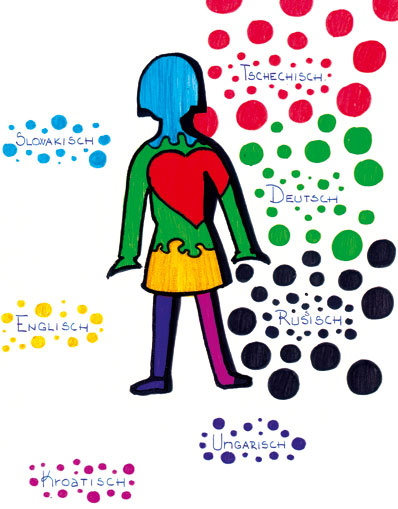
Well, technically, a language cannot be in your feet. If anywhere, it is located in your brain - that is, unless you let children draw language portraits.

Every language portrait starts with a simple silhouette of the human body. Children are now encouraged to colour them, with each colour representing one of the languages they know. They should also write comments or short texts explaining which languages they described and why they can be found in certain body parts. The idea behind language portraits is to make children think about the languages and cultures that influence them, and to show them that diversity is important. They should be proud of knowing more than one language instead of having the feeling that one of their languages is "bad" or "unwanted".

The descriptions (collected by Krumm, 2003) are insightful and sometimes heartwarming. One child, for example, wrote "German is in my head because it is the language my thoughts are in." Another one, however, said the reason for English being in his head is that he has to think a lot about it when speaking it.

I wanted to post my own language portrait at this point, but it is difficult, if not impossible, to draw one freely after all that I've read about them. Maybe I will let the topic rest for a while and add my own language portrait later. What would your portraits look like, though?

Wherever the languages you know are located, you cannot deny that they are a part of you and define who you are. I think Pentti Saarikoski put it best:

”Suomen kieli 
on minulle ikkuna ja talo
minä asun tässä kielessä
Se on minun ihoni.” 

It can be roughly translated as:
"The (Finnish) language
is for me like a window and a house
I live in this language
it is my skin."

Sunday, 16 March 2014

castles, caves and dangerous climbing

Yesterday some friends (that is Eva, Helene, Tom, Daniel, Magdalena) and I went on an adventure in Southern Styria! We took the train to Wildon, where we wanted to visit a castle from the 13th century that is now a ruin. After we had got off the train and walked a few hundred meters, we met a friend of Eva's by chance. He told us the best way to get to the ruin, which is on top of a hill.

the open-air stage
First we walked through the centre of Wildon with all its old buildings and wonderfully conserved facades. We even took a look inside the church. Then we followed a path uphill that led us to Wildon's open-air stage. However, after the stage, the path seemed to end and we did not know where to go. Eva called her friend to ask for directions again and according to him there should have been a visible path, but we couldn't make out anything as the ground of the forest was covered in leaves.


The ruins of the castle were directly above us, so eventually we decided to just head for them as best we could - that was when our relaxing hike turned into a rather exhausting and potentially dangerous climb! We were all very relieved when we finally reached the top of the hill. The ruins are scattered over the whole hill top, some of them almost perfectly conserved, others only pieces of stone walls.

Later we realized that there would actually have been a path leading to the ruins - we had simply come from the wrong side of the hill! Climbing instead of taking the path had been more fun, but we did not want to risk injuries on our way back down, so this time we took the safe path. On our way down we looked out for a cave called "Wilde-Mann-Höhle". We knew that is was supposed to be south of the castle and also what the entrance looked like because we had seen a video. It was impossible to find, however, and when we asked a jogger for directions he believed it had to be somewhere near the path we had taken before. By then we were all tired and hungry, so we gave up the search at this point and made our way back to the centre of Wildon.


When we left the path we noticed a sign that made us all laugh: "Access to site of the ruins prohibited - danger of collapse!" How good that we had come climbing from the opposite direction... :-)

Thursday, 13 March 2014

because we ♥ animals

If you still think that vegan food is boring, bland and not filling, let me present to you a restaurant that will definitely change your mind!

During a discussion about food in class, a girl from my group mentioned a vegetarian/vegan restaurant called Ginko. Today I did not feel like cooking myself so a friend and I decided to try the food there. Located in the city centre, the restaurant is easy to reach by public transport or bike. Ginko is a self-service restaurant, which means you do not sit down and wait for someone to take your order, but you pick up a plate and a tray and take your food from a buffet.


The buffet might look rather small at first, but believe me when I tell you that there is such a variety of dishes that deciding what to take is almost impossible. There were a number of different salads, but also warm food such as chili con soja or a chick-pea curry. My strategy was to simply load a spoonful of everything onto my plate - and of course I couldn't resist to also take a glass full of tiramisu with me.

All the dishes are either vegetarian or vegan and they are clearly labeled. If you have questions about the ingredients, for example because you have an allergy, the staff will gladly help you. In my opinion, this is a big plus. I suffer from an allergy myself and I have often experienced in other restaurants that the staff did not actually know what exactly their dishes were made of, which left me frustrated and slightly worried.

In Ginko, the cost of your food is calculated by its weight. I had expected it to be rather expensive, so I was surprised when it was only €10 for a plate full of most of the things from the buffet, a dessert and a drink! Of all the things on my plate, there was absolutely nothing I did not like the taste of. My favourite was the chick-pea curry, though, because I love dishes that have curry in them - or then maybe it was the tiramisu that was my favourite. :-)


A last point worth mentioning is the friendly and welcoming atmosphere. In Ginko, you will see all types of people - from businessmen to students, even some very old people who generally tend to be of the opinion that any decent meal must include a chunk of meat.

If you are a vegetarian or vegan, I guarantee you that this will become your new favourite restaurant - and if you're not (yet) vegetarian, this place might just change your mind... :-)