Showing posts with label freepost. Show all posts

Thursday, 17 July 2014

First impressions

Three days ago I arrived here in New Romney, a small town on the South-East coast of the British island, where I will be spending the next two and a half months. Why, you ask? For an internship! 

I chose an internship instead of going abroad with Erasmus because this way I can make good use of the three months of summer holidays we have at university. I only applied for this one internship and kept my fingers crossed - and I was not disappointed :) Unfortunately, it is all voluntary, which means I don't get paid to work here.

When I arrived at the train station, a British girl came to pick me up with her car. She brought me to the hotel where I'm staying. On the drive, I asked her to recommend some places to see, which she gladly did :-) When I arrived at the hotel, there were three or four people in the lobby, and as soon as they saw me, they all exclaimed, "You're the new one!" - something I would hear another 50 times or so in the next few days. Our house manager, a guy called maxime, gave me a short tour through the building and afterwards I carried my suitcases to my bedroom.

I have to share the room with another intern, a girl from Germany - not very helpful in terms of speaking English... :-( The room is quite simple and still a bit chaotic - I haven't unpacked all of my things yet and Derya, my roommate, used to have the room to herself and so her things are still scattered everywhere. However, we are lucky because unlike others, we have our own fridge.

There is a kitchen downstairs from where we can take food at any time of the day as long as we eat it in the kitchen and don't carry it anywhere else. Theoretically, we have to cook all our meals on our own, but there is a "cooking team" of four or five interns that normally prepares lunch and dinner for everyone.

The office where all of us interns are working is in the same building where I'm sleeping - I only have to go downstairs and I'm at work! That means I can sleep longer than many others who stay in hotels that are further away, but it also means that working time and free time don't feel as separate as it should.

I usually work each day from 9 to 6, but the last hour consists of a workshop. In these workshops, we usually talk about ways to communicate more effectively, or there are teambuilding exercises. Today, for example, we had to think of a sketch that included 6 ping pong balls and a roll of black garbage bags...you can imagine how much creativity we  needed to include these requisites in a sketch!

Many interns spend their evening in the kitchen, cooking dinner and talking with each other, but I prefer to leave the house after work and go outside because I don't have a "second dinner" (the first one is prepared by the cooking team) and in the kitchen it feels too cramped and noisy to relax after a long working day. It is much more relaxing to take a long walk at the beach - today I even talked to some locals there :-)


So far, I feel very welcomed here and I like the international atmosphere - there are inters from many European and even African countries. One thing I have yet to get used to is that you are never alone here. I am used to living on my own and I am someone who needs time alone to relax and calm down, so it can be very exhausting to constantly be surrounded by people.

Sunday, 15 June 2014

M'athchomaroon!

If you are a Game of Thrones fan, you might already know what I'm talking about...if not, let me clarify this: M'athchomaroon is the equivalent for "hello" in the fictional language of Dothraki. Dothraki was created specifically for Game of Thrones by this guy:

David J. Peterson

David J. Peterson is a linguist who really likes to invent new languages - but not the kind of "oh, let's substitute each letter in the alphabet with a strange sign" kind of language most of us invented at some point when we were children. No, David puts a lot more effort into his work as you can best see on his homepage.

For each language, he explains all the rules from pronunciation to morphology to orthography for whoever has the will and nerve to read through it. Each language is more or less based on the grammar rules of a real language. For example, there is 'Kamakawi' (which means 'rainbow'), a language based on Hawai'ian. It is one of the more "evolved" languages on his homepage, and by evolved I mean that David provides more specific grammar rules and a larger vocabulary for Kamakawi than for some of the other languages. For example, he uploaded a list of Kamakawian names and their meaning!

Some other examples of languages David created are 'Gwedyr', a language based on the Finno-Ugric vowel harmony and noun cases, and KNSL, a sign language.

I think his work is pretty impressive, but it must also be quite sad to be the inventor of a language and therefore probably its only speaker. The meaning of language is to make communication easier, but if you cannot speak that language with anyone because nobody knows it, this is very frustrating. Also, if you are the creator of a language you know all its rules because you are the one who makes them. There is no one who knows the language better than you - so there is no one you can look up to and learn from.

Friday, 6 June 2014

Honey, honey, honey...

...life is funny? Not for the bees anymore! It is not completely clear why so many of them die each year, but among the main reasons are definitely the pesticides used in today's agriculture and the Varroa mite, an insect that is a deadly hazard for the bees. Another cause could be monocultural farming, where farmers only plant one crop on a large area. It drastically reduces the variety of food available to the bees. Bees are essential for a healthy ecosystem though, because they pollinate plants and help them to reproduce. Without bees, plants wouldn't survive and we would have nothing to eat!

A few weeks ago I saw a documentary about bees and what happens now that so many of them die. If you are interested, you can follow this link and watch it yourselves. I had heard about the bee discussion before - an Austrian politician had brought it up, but he was often made fun of. I didn't know how grave the problem was until I saw the documentary. 


The most shocking scene was one where they show an apple tree plantation in China. The Chinese farmers had used so many pesticides that all the animals in the area basically became extinct, which means that there are no more bees that can pollinate the apple trees. A plantation doesn't work if the plants don't reproduce themselves, so the owners now hire humans to pollinate the apple trees! They collect pollen from healthy apple trees on a plantation far away, bring it to the chemical-infested plantation and climb every tree in order to put the pollen on the apple trees. It may be a funny sight, but in reality it is one of the most tragic things I have ever seen.

A few days later, I read a newspaper article about a 23-year-old Austrian girl who had a great business idea. The name of their company, 'Rent a bee', says it all. On their homepage, you can rent a beehive for two months. You don't need to know anything about bees or beekeeping, all you have to do is open the beehive door in the morning and close it at night, and you have to provide water for the bees. After two months, you return the beehive and you receive all the honey your bees produced in the last two months, which can be as much as five kilos! If you became interested in beekeeping, they also offer a tutorial and all the equipment needed for harvesting the honey yourself.

Unfortunately, the beehives are all delivered in April. If I could get you excited about having your own beehive, you'll have to wait until next year to get one, sorry. In the meantime, why not get an insect hotel like the one in the picture that provides shelter for different kinds of insects?

Thursday, 29 May 2014

Science meets Comedy

You think science only involves boring equations, difficult formulas, numbers, data... - anything but fun? Read this post and think again!
Maybe some of you know poetry slams. After all, they have become quite popular recently. In a normal poetry slam, an artist has five minutes to present a text he or she has written themselves. Whispering, shouting, screaming - everything is allowed, but they must not sing (at least not during their whole performance) or use instruments. Also, artists are not allowed to use any requisites. In a poetry slam, the audience decides who wins by rating the performances with numbers or applause.

While in a normal poetry slam you should entertain your audience or make them re-evaluate their view of a topic, in a science slam the main goal is to inform the audience about your field of research. If you can entertain them at the same time, or change their views on your subject - even better! Performers of a science slam are apparently allowed to use requisites, and they have six minutes instead of five for their presentation.

In a science slam, it is less important to pay attention to the language you are using. Performers don't need to think of clever rhymes or puns, it is more important to explain their work in a simple way and show why they are fascinated by it. Most importantly, maybe, they are trying to convince the audience that research is not just something that happens far away from our daily lives in laboratories, but something that concerns us all and can make our lives easier and better.

In Austria, science slams take place approximately every three months, but the location changes, so it might take a while until there is one in a city near you. In the meantime, you can watch this video of Martin Moder, who was elected best Austrian science slammer and will take part in the European science slam finals later this year. Unfortunately, the video is in German. Generally, science slams don't seem to be popular in the English-speaking world yet. You can try your luck on youtube, where some of the videos have at least English subtitles.

Fans of the "real" poetry slam might denounce science slams because they differ too much from the original concept of a poetry slam, especially because they don't pay attention to linguistic aspects. However, I think they are a great way to bring various fields of scientific research closer to a large audience. Maybe they will encourage someone to study something scientific, or maybe it will change someone's mind about genetic modification and the like.

Sunday, 11 May 2014

a creative waste of time

Talking on the phone...
in a boring lecture at university...
on a long bus/train ride or flight...
What do we do? We start doodling.
Nothing special, right?

Wrong.
Some people have realized the creative and meditative potential that lies in everyday doodling. They thought that this form of art needs more recognition and coined the term "zentangling". Zentagles are usually drawn with a black pen on paper squares that are 9cm in width. They consist only of a variety of repetitive abstract patterns, lines and curves. Since the patterns are abstract, there are no mistakes and you are not supposed to erase anything. This website, for example, has collected many different patterns, instructions and variations. Zentangle has its own website, where you can read about their philosophy and methods. They also have a blog where you can see wonderful doodles.

At first, I found it quite ridiculous that Zentangle is promoted so excessively, with its own website, books and a drawing kit with tiles and pens you can order. Nonetheless, I was bored and suddenly felt like drawing some of the patterns I had seen online. 

The first one did not turn out very pretty. In fact, I was disappointed that my pattern looked nothing like the one I had seen online, but I had a sudden motivation to try another one. I put on some relaxing music - this playlist by Justin Vernon, by the way - and started tangling again. At some point, I heard a knocking at my door. It was my mum, who was furious because I had been on the computer (listening to music) for more than two hours. Yes, I spent two full hours doodling!

These are the ones I drew:


If I said that those were two wasted hours, I would be lying. Actually, the doodling was a form of meditation and I feel completely relaxed now. It is also oddly rewarding to be creative in such a simple way.
I still feel opposed to the fact that something so natural as doodling is being commercialised, but that does not mean that doodling itself is a worthless pastime. Quite the opposite, it is challenging and at the same time calming - two hours doodling are definitely more fun than two hours of watching TV.

As always, there are some people who put more effort into their work than others, and their doodles are undeniably works of art:


Saturday, 3 May 2014

Let's vote!

“We must go back to teach Europeans to love Europe.”
Jean Claude Juncker, Prime Minister of Luxembourg, El Pais, 2004

From May 22 to May 25, millions of people will have the right to elect the new members of the European Parliament, in short EMPs. In the last elections in 2009, only a little more than 43% of all EU citizens used their right to vote, and I fear that the number will not be much different this year. In my opinion, one of the main problems is that many people have no idea what the European Parliament actually does. To be honest, I had no idea either, but I decided to investigate and present you a summary here.

There are 751 MEPs representing the citizens of the European Union in the European Parliament. How many members a state can elect depends on its size, but no state has less than six representatives. The largest state, Germany, has 96. Normally, MEPs with similar political views – regardless of their nationality - will form fractions in order to make it easier to represent their interests.

What does the European Parliament do? In short, it has three main roles:

passing European laws
The Parliament receives a proposal, an idea for a law, from the Commission. It discusses the law and can make amendments. The proposal is then sent to the Council, and if the Council approves it it becomes a law. If the Council does not like the idea, it will be sent back to the Parliament for a second reading, where the proposal can be accepted, amended again or rejected.


controlling and monitoring the Commission to make sure they are working democratically
The Parliament can examine reports produced by the Commission, or it can question Commissioners. If necessary, the Parliament can set up committees of inquiry.
When national leaders meet for European Council summits, Parliament gives its opinion on the topics on the agenda.

budgetary power
The Parliament and the Council propose a number for the annual budget of the EU. Like with laws, the Parliament and Council need to be of the same opinion in order for the budget to be adopted. The Parliament can amend the budget plan. 

Here is a short video summarising the election process:


I hope you feel better informed now. See you at the elections, hopefully :-)

If you want to read more about MEPs, these are the pages I took the information from:
http://europa.eu/about-eu/institutions-bodies/european-parliament/index_en.htm
http://www.eu2014.at/europawahl-2014-faq/ (in German)

Sunday, 20 April 2014

My favourite dish

Today I want to show you how to cook my favourite dish, lecsò, which is a Hungarian vegetable sauce.
I usually cook intuitionally, which means I do not normally weigh or measure anything, so the weights and measures I tell you are only an estimation.


For two servings you will need:

  • 2 tomatoes or approx. 10 cherry tomatoes
  • 1 bell pepper
  • 1 onion
  • other vegetables, if you like, such as mais or courgette
  • paprika
  • curry powder
  • vinegar
  • salt
  • pepper
  • oil
Heat a splash of oil and chop the onions, then fry them. In the meantime, cut all the vegetables into small chunks. First add the tomatoes, then the bell pepper. Stir for a while. The tomatoes should lose some of their water and give the lecsò its saucy texture. If not, you can add a splash of water. Then add the courgette, mais or other vegetables. Let it simmer for 5-10 minutes. Make sure to check every now and then if there is enough water in the pot, otherwise add a splash. Only now should you season the lecsò. Add two teaspoons paprika, half a teaspoon curry powder and one tablespoon vinegar. If you like hot food, you can also add a pinch of ground ginger or chili powder. Season with salt and pepper and let it simmer for another 5 minutes. It is best served with rice or pasta.


I love this dish because it is simple and can be prepared in a matter of minutes. This way, I can eat a decent and healthy lunch even when I do not have much time. Due to its simplicity you can try countless variations. For example, in autumn, when tomatoes and bell peppers are not in season anymore, I like to use chunks of pumpkin and add cumin in addition to the other spices.

Friday, 11 April 2014

strolling through a food paradise

Whenever I am on holiday, there is one place I never miss out on: market halls.
They are maybe not the most touristy or special places, but that is why I like them so much. As soon as you enter a market hall, an eclectic mix of smells welcomes you. It is a pleasure to look at all the fresh, local food - and try free samples where possible. There is usually also a small cafe or restaurant where I like to stop by to watch the bustling crowd while enjoying a freshly brewed coffee or meal.

piirakka
The largest and most impressive market hall I have been to is the one in the harbour of Helsinki. There is a big section dedicated to fish - obviously, as fish is always present in the Scandinavian cuisine. If you ever happen to be there, make sure to try a piirakka. It is a traditional Finnish pastry made out of rye dough filled with rice pudding or mashed potatoes. It can be eaten as a warm or cold snack.

I also visited a market hall in Oulu, a town in the north of Finland. It is smaller than the one in Helsinki and mainly dedicated to fish and meat, but they also sell hand-made souvenirs. It is located next to the sea, so on a warm day you can eat whatever you bought at the market sitting at the small harbour. When I was there, however, it was too cold and windy and we hurried back home to prepare the fish we had bought as soon as possible. It was the best grilled salmon I have ever eaten, by the way. Fish just does not taste the same here at home, where it is not cooked within a few hours after it has been caught.

I definitely had the best time at a market in Florence, though. It is called Mercato Sant'Ambrogio and there are mainly locals because tourists usually go to the central market. I was in Florence because I did a language course there, and we went to the market on our last day as part of a final quiz. Each group got a sheet with questions, and our task was to interview the Italian customers and salespeople to find out what we needed to know. For example, we had to ask for prices or find out what kind of food a certain word meant. It was sometimes tricky, but a fun way of learning new words and overcoming the reluctance to speak a foreign language in public.

Thursday, 3 April 2014

"To Berlin, please!"

An adventurous journey, for free: sounds like (almost) every person's dream, doesn't it?

Well, all the lucky ones who were chosen to take part in the "Can you make it"-challenge will get exactly that! The goal of this challenge is to make it from a certain starting point - one of four cities in Europe - to the finish line in Berlin in a matter of seven days. 

Piece of cake, you will think - but of course there is a catch. The participants cannot use any money, including credit cards, nor can they have a personal mobile phone. They only get a few cans of energy drink which they can try to trade. They have to rely on luck, hospitality and their negotiating powers in order to get food, a place to sleep and - most importantly - a ride to their next checkpoint. The participating groups cannot just choose any route they want, but they have to pass six checkpoints on the way, where additional challenges are waiting for them. If the participants master them successfully, they earn more energy drink that can be traded for other goods.


All participants are travelling in groups of three and have to stay together at all times. There are several other rules that must be obeyed, otherwise they will be disqualified. If participants are sure that they will not reach Berlin on time, they can always give up and travel home - but seriously, who would admit defeat and not keep fighting until the very last minute?

As far as I have read from the homepage, there is not just one winner. Everyone who manages to arrive in Berlin on time is a winner, and on top of the unique experience they have had they are invited to an awesome party :-)

This year there is also a group from the University of Graz who will take part in the challenge. I am going to follow their adventures online for the next week. Their starting point will be London. I am especially curious how they are going to make it across the sea!

The application for the next challenge probably won't start until next winter, but who knows, maybe you will see me and two of my friends in next year's challenge, trying to make it from one place to another only relying on luck and our charm!

Saturday, 29 March 2014

Music

As you might (or might not) know, I am going to spend the whole summer break in the UK this year. For this reason I am currently trying to put together a summer playlist. Music is very important for me whenever I go abroad because it makes spending hours on planes, trains and busses less boring. Also I will connect it to memories of the places I have been, so whenever I listen to a holiday playlist later on, I will be taken back to this place and the feelings that are connected with it.

I wanted to take this chance and introduce you to some bands whose songs will be part of my playlist.

First of all, there are The Naked and Famous. They are a band from New Zealand that has only released two albums so far. I think it is difficult to define music by certain labels, but if I had to, I would say theirs is synthpop or indie pop. Many of you will know their songs Young Blood or Punching in a Dream from their first album, Passive Me, Aggressive You. Here is a video from their new album, In Rolling Waves, which I will put onto my playlist:


By the way, I am looking forward to seeing them live in June! :-)

The second band on my playlist are Crystal Fighters. When I saw them live at a music festival in 2011, I did not like them at all - actually I thought they were just a group of drug addicts that make crappy music. However, a while ago a friend re-introduced me to them and I started to like their new album, Cave Rave. The video is for their song At Home, which is not on their new album, but still on my playlist because it is wonderful and dreamy.


One band, or rather collaboration, that deserves more attention in my opinion is Volcano Choir. I called it a collaboration because it consists of the members of an instrumental band called Collections of Colonies of Bees and Justin Vernon from the band Bon Iver as a singer. I especially like their songs Comrade, Byegone and Alaskans. Altough, if you decide to listen to Comrade, promise me to listen to the whole song. I did not like the beginning when I heard it for the first time either and was about to skip the song when the refrain started and got me caught.

A band that never ceases to amaze me is Alcest. Every album they release sounds so different from the last one, yet they never fully abandon their typical dreamy style. I love Away from their newest album, Shelter. It is one of the few songs with English lyrics they have. Their lead singer is French, so obviously the lyrics are usually French too. Promise me to listen to Tir Nan Og, which is by far their most brilliant song. You cannot deny that it makes you feel as if you were riding a unicorn through a haunted forest! As far as I know, though, the lyrics are based on an old Irish tale and are in Gaelic.

I think I have given you enough to listen to for a while, but maybe I will let you know more about the bands and singers I like at a later stage.

Saturday, 22 March 2014

English is in my feet

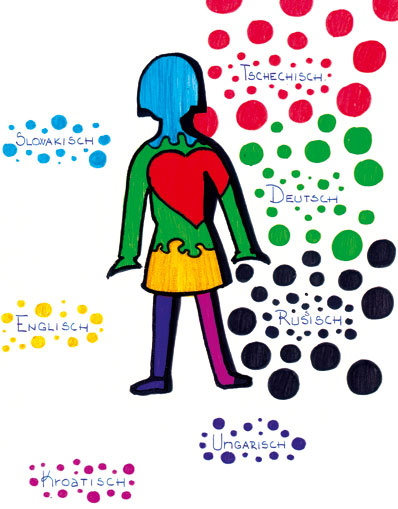
Well, technically, a language cannot be in your feet. If anywhere, it is located in your brain - that is, unless you let children draw language portraits.

Every language portrait starts with a simple silhouette of the human body. Children are now encouraged to colour them, with each colour representing one of the languages they know. They should also write comments or short texts explaining which languages they described and why they can be found in certain body parts. The idea behind language portraits is to make children think about the languages and cultures that influence them, and to show them that diversity is important. They should be proud of knowing more than one language instead of having the feeling that one of their languages is "bad" or "unwanted".

The descriptions (collected by Krumm, 2003) are insightful and sometimes heartwarming. One child, for example, wrote "German is in my head because it is the language my thoughts are in." Another one, however, said the reason for English being in his head is that he has to think a lot about it when speaking it.

I wanted to post my own language portrait at this point, but it is difficult, if not impossible, to draw one freely after all that I've read about them. Maybe I will let the topic rest for a while and add my own language portrait later. What would your portraits look like, though?

Wherever the languages you know are located, you cannot deny that they are a part of you and define who you are. I think Pentti Saarikoski put it best:

”Suomen kieli 
on minulle ikkuna ja talo
minä asun tässä kielessä
Se on minun ihoni.” 

It can be roughly translated as:
"The (Finnish) language
is for me like a window and a house
I live in this language
it is my skin."

Sunday, 16 March 2014

castles, caves and dangerous climbing

Yesterday some friends (that is Eva, Helene, Tom, Daniel, Magdalena) and I went on an adventure in Southern Styria! We took the train to Wildon, where we wanted to visit a castle from the 13th century that is now a ruin. After we had got off the train and walked a few hundred meters, we met a friend of Eva's by chance. He told us the best way to get to the ruin, which is on top of a hill.

the open-air stage
First we walked through the centre of Wildon with all its old buildings and wonderfully conserved facades. We even took a look inside the church. Then we followed a path uphill that led us to Wildon's open-air stage. However, after the stage, the path seemed to end and we did not know where to go. Eva called her friend to ask for directions again and according to him there should have been a visible path, but we couldn't make out anything as the ground of the forest was covered in leaves.


The ruins of the castle were directly above us, so eventually we decided to just head for them as best we could - that was when our relaxing hike turned into a rather exhausting and potentially dangerous climb! We were all very relieved when we finally reached the top of the hill. The ruins are scattered over the whole hill top, some of them almost perfectly conserved, others only pieces of stone walls.

Later we realized that there would actually have been a path leading to the ruins - we had simply come from the wrong side of the hill! Climbing instead of taking the path had been more fun, but we did not want to risk injuries on our way back down, so this time we took the safe path. On our way down we looked out for a cave called "Wilde-Mann-Höhle". We knew that is was supposed to be south of the castle and also what the entrance looked like because we had seen a video. It was impossible to find, however, and when we asked a jogger for directions he believed it had to be somewhere near the path we had taken before. By then we were all tired and hungry, so we gave up the search at this point and made our way back to the centre of Wildon.


When we left the path we noticed a sign that made us all laugh: "Access to site of the ruins prohibited - danger of collapse!" How good that we had come climbing from the opposite direction... :-)

Thursday, 13 March 2014

because we ♥ animals

If you still think that vegan food is boring, bland and not filling, let me present to you a restaurant that will definitely change your mind!

During a discussion about food in class, a girl from my group mentioned a vegetarian/vegan restaurant called Ginko. Today I did not feel like cooking myself so a friend and I decided to try the food there. Located in the city centre, the restaurant is easy to reach by public transport or bike. Ginko is a self-service restaurant, which means you do not sit down and wait for someone to take your order, but you pick up a plate and a tray and take your food from a buffet.


The buffet might look rather small at first, but believe me when I tell you that there is such a variety of dishes that deciding what to take is almost impossible. There were a number of different salads, but also warm food such as chili con soja or a chick-pea curry. My strategy was to simply load a spoonful of everything onto my plate - and of course I couldn't resist to also take a glass full of tiramisu with me.

All the dishes are either vegetarian or vegan and they are clearly labeled. If you have questions about the ingredients, for example because you have an allergy, the staff will gladly help you. In my opinion, this is a big plus. I suffer from an allergy myself and I have often experienced in other restaurants that the staff did not actually know what exactly their dishes were made of, which left me frustrated and slightly worried.

In Ginko, the cost of your food is calculated by its weight. I had expected it to be rather expensive, so I was surprised when it was only €10 for a plate full of most of the things from the buffet, a dessert and a drink! Of all the things on my plate, there was absolutely nothing I did not like the taste of. My favourite was the chick-pea curry, though, because I love dishes that have curry in them - or then maybe it was the tiramisu that was my favourite. :-)


A last point worth mentioning is the friendly and welcoming atmosphere. In Ginko, you will see all types of people - from businessmen to students, even some very old people who generally tend to be of the opinion that any decent meal must include a chunk of meat.

If you are a vegetarian or vegan, I guarantee you that this will become your new favourite restaurant - and if you're not (yet) vegetarian, this place might just change your mind... :-)

Saturday, 8 March 2014

Ready, set, shoot!

Are you as enthusiastic about photography as I am? If the answer is yes, you will be thrilled to hear about the photography marathon.

"A marathon? But I'm not sporty!"


Don't worry, a photography marathon is not so much about running - unless you are bad at time management, because you have exactly twelve hours to complete it. In those twelve hours, your goal is to take 24 pictures to given topics. The topics are kept quite general, for example "yellow", "fragile" or "window" so that the participants can be very creative.

There are only a few rules you have to obey if you want to take part in such a photo marathon:
  • You have to use a digital camera, and you cannot use your mobile phone.
  • You have to sign up in advance and pay a participation fee.
  • At the end of the day there have to be exactly 25 pictures in the right order on your memory card.
  • You have to return the memory card by 9pm.


On the day of the marathon, you can collect your starting number at 9am and then it's time to shoot some wonderful pictures - but don't forget that your first picture has to be the one of your starting number. Even there you can already be creative. For example, take a look at the participant number 33. He took a picture of bus line number 33!

As I said before, you have to return your memory card at the end of the day and a jury will then have a look at all the pictures. The winners will be informed about a month after the marathon and will be invited to a ceremony. There are always valuable prices such as cameras!

There will be a photo marathon this May or June in my city. Some friends and I are planning to participate - I will let you know how it was afterwards!

Monday, 10 February 2014

The "Friendly Alien"

No, I did not meet a very gentle extraterrestrial being - "Friendly Alien" is simply the nickname of the Kunsthaus, the most peculiar building in Graz when it comes to architecture.


It was built in 2003, when Graz was the European Capital of Culture. The Kunsthaus is an art gallery dedicated to contemporary and modern art. There are no permanent exhibitions so every few months you can see completely new works of art that have never been displayed in the Kunsthaus before.

I visited the Kunsthaus last weekend with an exchange student from Canada because she was curious what it was like inside and I had never been inside before either, which is quite a shame since I have been living not too far away from this special building all my life. 

On the first floor there was a modern art exhibition from local artists and I have to say, the charm of modern art will forever remain a mystery to me... On the second floor there was an exhibition from two Russian artists, which I found more fascinating. You could see the whole process of creating a work of art, from the first sketches to the actual painting or even a 3D model of a fantasy building. We could tell from the dates that it sometimes took the artist years to finish a painting or model, and that many changes were made in the process. The effort the artists had put into their work really fascinated me, especially because art is something done for the sake of it, and not primarily for profit or approval. The artist cannot know whether his work of art will be accepted or liked, yet he spends years on one.

I would like to share one picture that I took with you:


This mirror was mounted in the staircase, and at first I wondered why you would need a mirror there. After all, people are not likely to crash into one another in a big staircase like this. I found it a nice idea, though, until I realized that I was fooled - the "mirror" was not a mirror at all, but a painting! :-)


Tuesday, 4 February 2014

What's the word for...?

Huh, I haven't been blogging for a while. :-(

My first semester at university is over, all the exams are written and I can finally lean back and relax...or not? Unfortunately, the information saved in our brains tends to be forgotten faster than we would like to imagine if we don't revise regularly, so I decided to revise all the vocabulary I studied in the course of the semester. A friend of mine and I are also going to try and enforce a "no German" policy when we are meeting friends that are all English students.

When we were trying to hold a conversation only in English, and by conversation I mean one covering more more substantial subjects than the weather, we soon realized that we are lacking English words for everyday items that surround us. Something had to be done about this circumstance!
Our solution: We labelled many of the items in my apartment with Post-Its on which we wrote the correct English expression (both the American and British version, where there is an option). On the picture you can see some of the kitchen utensils we labelled. 


Then we walked through the apartment, reading all the words out loud in order to remember them, and when we were convinced that we know most of them, we played the game "I spy with my little eye [something that is green/made of plastic/soft...]".

It was a fun way to learn new vocabulary and I think I'm going to label all the items in my apartment again in the near future, but this time in Italian, my second language. If you have any other ideas how to learn new words in a playful way, let me know :-)

Thursday, 5 December 2013

Santa Claus is coming to town

Every year millions of children (and adults, too) are waiting impatiently for the arrival of  a short, fat guy in a red suit that brings them presents: Santa Claus. Where did the original Santa Claus come from and why did he devote his apparently immortal life to bringing children presents on Christmas?

Usually, a saint called St Nicholas is acknowledged as the original Santa Claus. We know little about this man for certain. He probably lived in Myra, in the south-west of modern Turkey, in the fourth century. St Nicholas, who was a bishop in his home town of Myra, is likely to have died on 6 December. This day was celebrated as his feast day in the medieval church, and still is his feast day in some countries today. 

One of the earliest legends about St Nicholas tells how he heard of a man who could not afford the dowries for his three daughters. The man therefore intended to make his daughters work in a brothel. St Nicholas saved them from their fate by throwing three bags of gold through their window at night.

This tale is often seen as the root of St Nicholas as a gift giver. He also appears to have taken on some of the qualities that originally belonged to pagan gods such as Poseidon or Wodan.

Throughout the Middle Ages, the legend of St Nicholas spread enormously. In addition to being the patron of sailors and unmarried women, he also became the patron of children. The most significant change, however, was brought about by the introduction of the Dutch Sinterklaas. Sinterklaas clearly derives from St Nicholas and his feast-day on 6 December, but he differs from earlier portraits of the Christian saint. Sinterklaas, for example, has got a flying white horse. This may derive from the fusion of St Nicholas with pagan gods (Wodan did possess a flying horse).

It seems likely that St Nicholas became an American tradition in a period following the Revolutionary War, when Americans became interested in Dutch customs. However, it was probably Clement Moore who fixed the image of Santa Claus so firmly in the American mind. He wrote a poem called "A Visit from St Nicholas" in 1822. Moore added some elements from German and Norse legends to the Dutch Sinterklaas. In his poem, St Nicholas is a tiny man with a sleigh drawn by eight miniature reindeer. He stops at every house and comes down the chimney to fill stockings with gifts. The poem was published anonymously and became very popular under the name "The Night before Christmas".

As time went by, more and more details were added to the legend of St Nicholas. Thomas Nast, a cartoonist, did a series of drawings of St Nicholas. His version of Santa lives at the North Pole, has a workshop for building toys and a large book filled with the names of all the naughty and nice children. In the 19th century Santa was often shown wearing outfits of different colours including purple, green and blue. The Coca-Cola company is often said to have made popular the image of Santa dressed in the colours red and white because those are the company's colours. However, the other colours had already faded out by the beginning of the 20th century and most of the time Santa was associated with the colours red and white.